


 Flagship
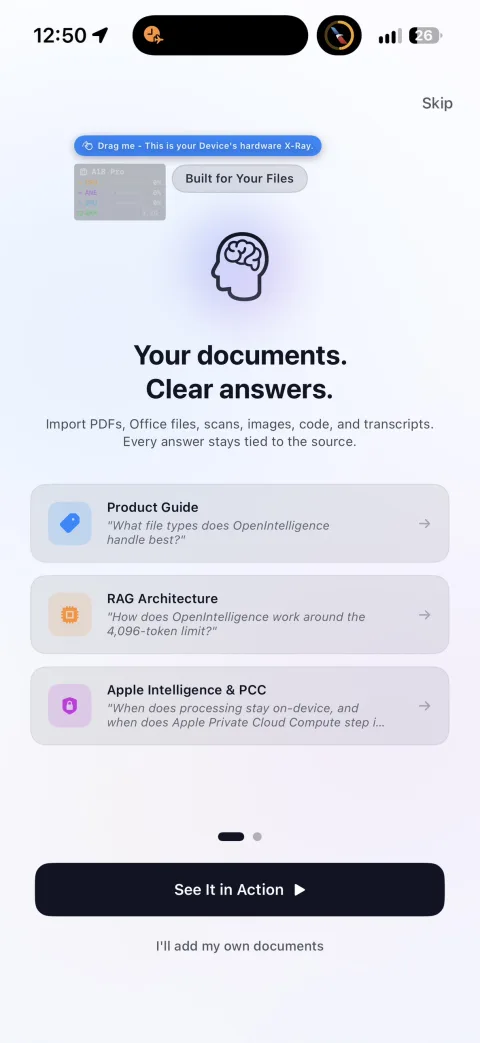
An open-source private document intelligence app for iPhone, iPad, and Mac. It turns files and media into searchable libraries, answers with inspectable citations, and shows which execution route actually ran.Version 5.4 on the App Store. Answers on your device, or on Apple Private Cloud Compute after you approve what is sent. Lifetime is 33% off in the US until September 29.
Why: I wanted private document search that did more than produce a confident paragraph. I wanted to ask a question, inspect the evidence behind the answer, and know whether it ran on my device or used an Apple-managed route. That became OpenIntelligence: a native document workspace built around retrieval, citations, verification, and explicit execution policy.
Private Cloud Compute routing: Version 5.4 decides where final synthesis runs only after retrieval, when the evidence and real context size are known. On iOS and macOS 27 a long evidence-heavy request uses Private Cloud Compute only after you have seen how much would be sent and why, and given permission; on older systems every route resolves on-device. Retrieval and verification stay local, and every answer carries a route badge.
Local retrieval & verification: Parsing, Vision OCR, indexing, SQLite FTS5 and vector search, reranking, evidence packing, citation checks, and abstention all run on-device. The app still works in airplane mode through its on-device answer path and does not require an account or API key.
More than PDFs: The ingestion pipeline handles Office documents, spreadsheets, presentations, notes, scans, code, images, audio, and video, then keeps those different sources searchable inside the same private library.
Building in the Open: Since releasing it, I’ve opened up the project to the public. To manage the workflow, I set up a single-source-of-truth Notion roadmap and built custom agentic skills, meaning AI assistants can now log bugs and add features to the roadmap directly from the terminal as I build.
What I learned: The model call is the easy part. The real work is getting the right evidence, preserving source structure, handling ugly files, refusing unsupported answers, and making the whole route visible enough that a user can verify what happened.

